Told You Might Need Back Surgery? Here's Why Thousands Are Trying Decompression at Home First
When a disc is pressing on the nerve, squeezing your back harder only makes it worse. A German-engineered belt does the opposite — it gently decompresses the lower spine. Here's what people want to understand before they agree to the operating table.

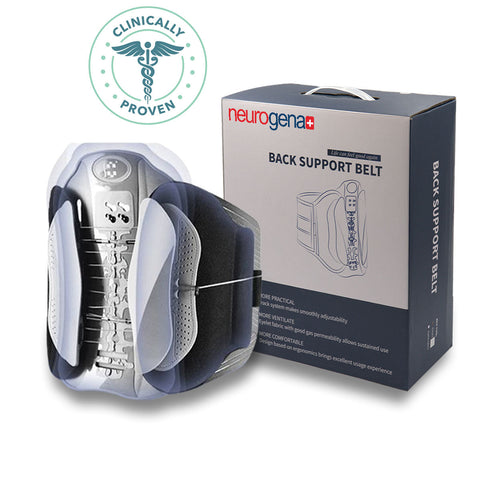
The Neurogena Back Support Belt — invented in the USA, engineered in Germany.
If sciatica or a herniated disc has shrunk your world down to a few painful minutes at a time — can't stand at the sink, can't walk to the mailbox, can't sleep — you already know the fear that comes next: the word surgery.
And the stories don't help. Plenty of people who had the operation say the same thing afterward: the scar tissue, the stiffness, "I wish I hadn't rushed into it." So a lot of people are asking a reasonable question first — is there a way to take the pressure off the disc before going under the knife? Here is what keeps coming up.
The pain isn't really in your muscles — it's a disc pressing on a nerve
That's why rubbing it, resting it, and stretching it never seem to hold. When a bulging or herniated disc is crowding the nerve root, the shooting pain down the leg, the numbness, the "can't stand up straight" — none of it eases until the pressure on that disc comes off.
Endless stretching can even backfire: if the disc is already under load, pulling on it aggressively can flare the nerve worse. What the disc needs is the opposite of pressure. It needs space.
Decompression does the opposite of an ordinary brace — it stretches the spine apart
A cheap elastic belt just squeezes your middle. This one is built to decompress: a rigid back plate holds the lumbar spine at its natural 26-degree curve, and a 10:1 compound pulley lets you gently draw the lower spine open — taking load off the disc — with one hand.
The 10:1 compound pulley amplifies your pulling force for even, adjustable decompression.
It's the same idea clinics charge for — at home, drug-free, non-invasive
Spinal decompression is not fringe. It's a standard tool in physical-therapy clinics, and people recovering from sciatica routinely name it as the thing that gave them the most noticeable relief — enough to finally sleep through the night. The difference here is you're not booking sessions; you're wearing it.
It was doctor developed — and tested on hundreds of patients
The belt wasn't dreamed up by a marketing team. It was doctor developed and, according to the maker, refined across a study of 276 participants dealing with exactly this kind of lower-back and nerve pain — which is why the arc, the plate, and the pulley are shaped the way they are.
4.7 stars, 627+ reviews — and a 60-day way to find out for yourself
Two things come up over and over in the reviews: the relief is fast, and it fits real bodies (sizes up to 3XL/4XL). The company backs it with a 60-day money-back guarantee — so trying the non-surgical route costs you nothing but the shipping label if it doesn't help.

"I'm 6'2", 300lbs and ordered an XL and it fit perfectly... it provides tons of support for my lumbar and sciatic."

Customer photo from a verified review.
Where to get it
Sold directly by Neurogena — and backed hard enough that trying it is risk-free.
$199.95$149
- 60-day money-back guarantee — no questions asked
- 2-year warranty included
- Ships from US warehouse in 3–5 days
- Sizes S/M to 3XL/4XL
683 Bought Today · 55,500+ Americans Already Bought
Quick answers
Can this replace surgery?
No. It is a support belt, not a medical device or a substitute for treatment. Many people use it to take pressure off the lower back while they explore non-surgical options — but if your doctor has recommended surgery, follow your doctor's advice. Always consult your physician about your specific condition.
Will decompression make a herniated disc worse?
Unlike aggressive stretching, the belt applies gentle, even, adjustable support rather than yanking the spine. Start with short sessions (about 30–60 minutes) and stop if anything increases your pain. If you have a diagnosed disc condition, check with your physician before use.
How fast will I feel something?
Many reviewers describe feeling the pull and some relief the moment they cinch it. Results vary from person to person, which is what the 60-day money-back guarantee is for.
This page is an advertisement for the Neurogena Back Support Belt. It is a wearable support product, not a medical device. Statements on this page reflect the manufacturer's product information and customer reviews and have not been evaluated by the Food and Drug Administration. This product is not intended to diagnose, treat, cure, or prevent any disease, and is not a substitute for professional medical advice, diagnosis, treatment, or surgery. Individual results may vary. If you have a herniated disc, sciatica, or any medical condition — or a doctor has recommended surgery — consult your physician before use.
