Why Sciatica Keeps Flaring Up — And Why The Walk Gets Shorter Every Month
It starts as a bad week. Then you are holding the shopping cart to get down the aisle. Here is what is actually happening in your lower back — and the one thing almost nobody hands you.

Sciatica is not a back muscle problem. It is pressure on a nerve that runs from the lower spine down the leg.
You noticed it at the store first. Halfway down the second aisle, the leg starts. So you lean on the cart, and leaning helps, so you keep leaning. A year later you plan the trip around which store has the shortest walk.
That is not you getting old and it is not you being dramatic. It is a very specific thing happening in one very specific place — and once you can see it, it explains every part of this that has never made sense to you.
Including the part that bothers you most: why it goes quiet for a week, and then comes straight back.
Four signs it has stopped being "back pain"
Plain back pain stays in the back. When the sciatic nerve is involved, the pattern changes. See how many of these you recognise.
- Sign 1The pain does not stay put. It runs from the lower back into the buttock and down one leg.
- Sign 2It changes character. A burning sensation, or a stabbing pain, instead of the dull ache you used to get.
- Sign 3It is one-sided. One leg, almost always the same one.
- Sign 4It is set off by position, not by effort. Stand or sit for more than about thirty minutes and it comes back — even on a day you did nothing.
Sign 4 is the one people get wrong. They assume they overdid it. They did not. Standing still and sitting still are two of the hardest things you can ask a loaded lower spine to do.
Why leaning on the cart helps — and why that is the clue
Watch what you actually do when it flares. You lean forward. Onto the cart, onto the counter, onto the back of a chair. And it eases.
There is a reason. Your lower spine is supposed to hold a gentle forward curve — about 26 degrees. That curve is what keeps the weight of your upper body spread across the bottom of the spine instead of dumped onto one spot.
When that curve flattens out, the load concentrates at the lowest joints. That is exactly where the sciatic nerve root leaves the spine. Crowd that spot and you get the leg pain — the burning, the stabbing, the ache that will not sit still.
Leaning on the cart takes some of that load off for a moment. It is not a habit. It is your body doing the only decompression available to it, with its hands full of groceries.
Which is why rest, stretching and pills keep letting you down
None of them are silly things to try. They just do not touch the position your spine is in when you stand back up.
| What you were told | What it actually does | |
|---|---|---|
| Rest it a few days | Lying down unloads the spine. The second you stand up, the load is back exactly where it was. | position unchanged |
| Stretch it out | Pulls on muscles that clamped for a reason. With a nerve already crowded, hard stretching can flare the leg worse. | position unchanged |
| Take something for it | Turns the pain signal down for a few hours. Nothing at all changes at the nerve. | position unchanged |
| A soft elastic belt | Squeezes your middle. Adding pressure is not the same as holding a curve. | position unchanged |
Every one of them is aimed at the pain. None of them is aimed at the curve — and the curve is what keeps handing the pain back to you.
So what would actually have to happen
Two things, together. Take the load off the bottom of the spine — and then hold the curve, so it does not just flatten again the moment you start walking.
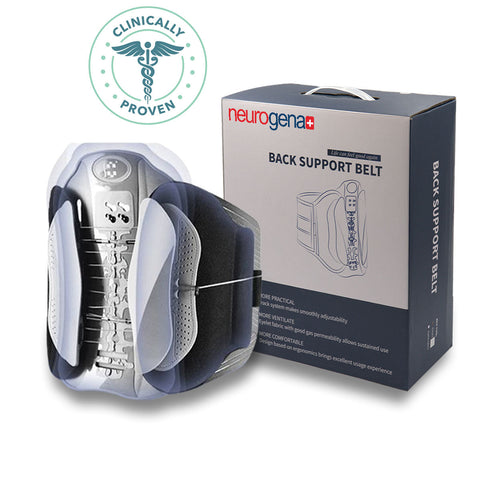
That is the whole job the Neurogena Back Support Belt was built around. It is a support belt, not a wrap, and it is put together like a piece of equipment.

The Neurogena Back Support Belt — invented in the USA, engineered in Germany.
First, the pull. A 10:1 compound pulley amplifies your force, so you can tighten it and apply compression in a matter of seconds, with just one hand. No wrestling with two straps against a wall. One hand, sitting in the car, before you walk in.
The 10:1 compound pulley — one hand, a few seconds, as tight as you want it.
Second, the curve. Behind the belt is a rigid arc with 3 arc settings, built to maintain the natural 26-degree curve of the lumbar spine while you stand, sit and walk. That is the part a fabric wrap can never do — it holds a shape instead of just squeezing.
Three arc settings hold the lumbar spine at its natural 26-degree curve. The support can be removed if you prefer.
Third, the sideways. Padded side supports give side-to-side control with removable inserts, to minimise the damaging movements of the spine — the twist as you reach into the trolley, the half-turn to the passenger seat. Those small ones are the ones that set it off.
Removable side inserts add side-to-side control.
The fabric is stitch free, made using German hot press technology, so it does not build up heat and moisture under your clothes over a long day.
You have been let down before. So here are the numbers
You are allowed to be suspicious. Most people reading this have already bought something that did nothing. So rather than adjectives, here is what the maker reports.

* Results according a consumer test with 276 participants. Individual results may vary.
Read the middle one again slowly, because it is the one that matters to you. Thirty minutes a day. Two weeks. Not a lifestyle overhaul.
4.7 stars, 627+ reviews — from people with the same leg
Two things come up over and over in the reviews: the relief comes fast, and it fits real bodies — sizes run from S/M up to 3XL/4XL.

"Product works as described. Sizing was fairly accurate. I'm 6'2", 300lbs and ordered an XL and it fit perfectly... it provides tons of support for my lumbar and sciatic. Would recommend!"
"I measure a 40" waist and my abdomen is about 44" and this worked fine for me. Well-made product. Easy to put on and take off. Almost immediate relief."
"Fast shipping, instant relief! ... AND you can really get it tight. If I'm out running errands I adjust it as tight as it will go. So far no tears and the velcro is staying attached. Great buy!!"

Customer photo from a verified review.
How you would actually use it
Three steps, and the box has the instructions in it.
- Step 1Wrap the belt around your lower back area.
- Step 2Gently pull the rope to the tightness you want.
- Step 3Attach the Velcro end to hold that compression in place.
Most people wear it for the walk, not for the day — the store, the garden, the drive, the long stand at the sink — and take it off after.
Where to get it
Sold directly by Neurogena — and backed hard enough that trying it costs you nothing but a shipping label.
$199.95$119
- 60-day money-back guarantee — no questions asked
- 2-year warranty included
- Ships from US warehouse in 3–5 days
- Sizes S/M to 3XL/4XL
55,500+ Americans Already Bought
Quick answers
How is this different from the back brace I already own?
Most braces compress — they squeeze the midsection, which adds pressure rather than holding a shape. This one is built around a 10:1 compound pulley and a rigid arc plate with three settings, so it takes load off and then holds the lower spine at its natural 26-degree curve. It is a different job, not a firmer version of the same job.
How long do I wear it?
The consumer test used 30 minutes a day. Most people start there and take it off every couple of hours for a break, so the muscles keep working naturally. It is support while you move, not something to live in.
Will it weaken my core?
That worry comes from wearing a brace all day, every day. Used in sessions, as above, it takes load off while you move — it is not there to replace your muscles.
How fast will I feel something?
82% of patients in the consumer test reported pain relief instantly, and several reviewers use the words "almost immediate". Results vary from person to person, which is exactly what the 60-day money-back guarantee is for.
Will it fit me?
Sizes run from S/M (45–75kg) up to 3XL/4XL (115–145kg). It was designed for overweight, hardworking backs, and the review page is full of larger frames saying it fits properly.
Can I wear it under clothes?
Yes. The fabric is stitch free, made using German hot press technology, so it does not build up heat and moisture. Reviewers wear it under a shirt without it showing.
I have a diagnosed disc problem. Is this safe for me?
Ask your physician first. The belt applies gentle, even, adjustable support rather than yanking the spine — but if you have a diagnosed condition or are under a doctor's care, that call is theirs, not ours.
What if it does nothing for me?
Send it back. There is a 60-day money-back guarantee, no questions asked, plus a 2-year warranty.
This page is an advertisement for the Neurogena Back Support Belt. It is a wearable support product, not a medical device. The description of the lumbar curve and nerve pressure above is a simplified explanation of how load and spinal position interact — it is not a diagnosis and not a recognised clinical classification. Statements on this page reflect the manufacturer's product information, its reported consumer test of 276 participants, and customer reviews, and have not been evaluated by the Food and Drug Administration. This product is not intended to diagnose, treat, cure, or prevent any disease, and is not a substitute for professional medical advice, diagnosis, treatment, or surgery. Individual results may vary. If you have sciatica, a herniated or bulging disc, or any medical condition, consult your physician before use.
