Health > Trending > Lower Back Pain
The 26-Degree Reason Your Back Pain Keeps Coming Back (It's Not What Your Chiropractor Told You)
If your lower back has been sore for months — if you've tried physical therapy, chiropractic adjustments, stretching, rest, even a cortisone shot, and the pain always finds its way back — this is worth five minutes before you try anything else.

Your lower back is supposed to hold a gentle inward curve. When it flattens, the load lands in one spot.
Six months ago I bent down to pick up my son from the car seat and something in my lower back seized up so hard I had to hand him to my husband and sit down right there on the sidewalk. He was crying. I was crying. And the worst part wasn't the pain — it was that this had happened before, and I still didn't know why.
Since then it's become a pattern I can set my watch to. Good for a few days. Then one wrong bend, one long shift on my feet, and I'm back on the couch with a heating pad, texting my manager that I can't come in — again.
My son is three now. He doesn't understand why some days Mom can't scoop him up off the floor. He just knows I say "not right now, buddy" more than I'd like to admit.
The shift I missed that day cost me a full day's pay. The one after that cost me a warning from HR. And somewhere in between, I started turning down plans with friends before they even asked — because I never knew, walking out the door, whether today was going to be a good-back day or a bad one.
That's the part nobody tells you about chronic back pain. It's not just the ache. It's the way you stop trusting your own body to show up.
I'm Denise. I'm 42. I work reception at a dental office, which sounds easy until you've stood at a front desk for eight-hour shifts, bent over filing cabinets, twisted to grab charts off low shelves a hundred times a day. I used to run 5Ks on the weekend. These days a flight of stairs makes me think twice.
Strong For Decades — Then Something Changed
By the time I finally admitted this wasn't going away on its own, I'd tried almost everything my insurance would cover.
| What I tried | What it cost me | How long it lasted |
|---|---|---|
| Physical therapy | 12 weeks, twice a week, $35 a visit | about 3 hours |
| Chiropractic adjustments | 8 visits over two months | about a day |
| Complete rest for a week | a week off my feet | made it worse |
| Lumbar pillow, heating pad, YouTube stretches | every morning before work | no change |
| Pharmacy brace | felt like a cardboard belt | slid up by lunch |
| An injection | one appointment | about 5 weeks |
Physical therapy first — twelve weeks of it, twice a week, $35 copay each visit. My therapist was thorough. Clamshells, bird-dogs, bridges — core work I did faithfully in my living room every night. It helped a little, for about three hours after each session. By the next morning I was right back where I started.
Then a chiropractor, on a coworker's recommendation. Eight adjustments over two months. Each one gave me maybe a day of relief — the kind where you walk out feeling loose and hopeful — before the tightness crept back in by dinner.
I tried resting it completely for a week, the way my doctor first suggested. That made it worse. Two days off my feet and I felt stiffer than before I started.
I bought a lumbar pillow for my desk chair. A heating pad that lived permanently on my nightstand. Stretches from three different YouTube videos, done religiously every morning before work. An over-the-counter brace from the pharmacy that felt like wearing a cardboard belt — it slid up around my ribs the second I sat down.
At one point my doctor brought up an injection. I got one. It bought me about five good weeks. Then the ache came back exactly where it had always been — low, to the left, worse by 3 PM.
None of it was fake relief. The PT genuinely helped my core. The chiropractor genuinely loosened something each visit. But every single fix was temporary — because not one of them was actually addressing what kept undoing the work in between appointments.
The Most Overlooked Cause of Back Pain That Keeps Coming Back

The loop: the curve flattens, the muscles take over, they tighten trying to compensate — and the curve flattens further.
What finally changed things wasn't a new treatment. It was a five-minute conversation with a physical therapist who wasn't even mine — she was covering for my regular one and happened to watch me stand up off the exam table.
"You're not falling apart," she said. "Your lower back just isn't holding its curve anymore."
I didn't understand what that meant, so she explained it in plain terms. Your lumbar spine is supposed to hold a natural inward curve — roughly 26 degrees — that keeps your weight balanced over your hips instead of dumping it straight onto your lower back muscles. Sit for eight hours a day, stand without support, favor one side while you lift and bend — and that curve slowly flattens out. Not from one injury. From thousands of small hours where nothing was holding it in place.
Once the curve is gone, your lower back muscles have to do a job they were never built to do alone — holding your whole upper body up, all day, unsupported. They tighten up trying to compensate. That's the soreness. Overwork them long enough and any small move — a bend, a reach, a car-seat lift — can trigger a flare, because the muscles are already maxed out just holding you upright.
That's why PT strengthened muscles that kept getting overworked again the next day. Why chiropractic adjustments loosened a curve that had nothing holding it in the new position an hour later. None of it was wrong. None of it was addressing the curve itself.
The belt she pointed me toward wasn't a generic brace. It's called the Neurogena LumbarLock™ — built around keeping that 26-degree curve in place for as long as you're wearing it, instead of just squeezing your midsection like the pharmacy brace I'd already tried and given up on. I'll be honest — I rolled my eyes a little. I had a drawer full of things that were supposed to fix this.
How Neurogena LumbarLock™ Targets the Root, Not Just the Ache
It comes down to three parts working together, and once she walked me through them, the design made sense.

Inside the belt: the support plate and the cord routing that does the pulling for you.
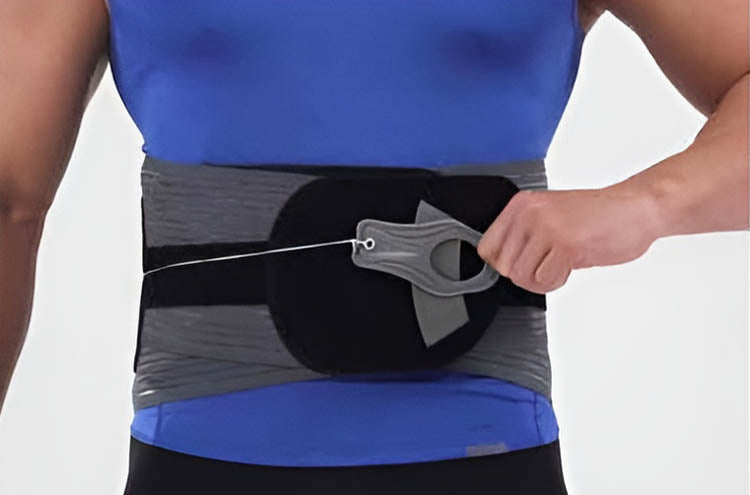
The first is what they call a 10:1 Compound Pulley System — instead of yanking two straps together with your arms, which, if your back already hurts, is its own special hell, you pull one cord and the pulley amplifies the force. It tightens the whole belt evenly with one hand, in seconds, to whatever compression you need that day.
One cord, one hand, a few seconds — as tight as you want it.
The second is the adjustable lumbar arc itself — three settings built to maintain the natural 26-degree curve of the lumbar spine, so the muscles around it aren't doing that job alone anymore. You can remove the support insert entirely if you prefer less structure on an easier day.
Three arc settings hold the lumbar spine at its natural 26-degree curve. The support can be removed.
The third is padded side support with removable inserts, which controls side-to-side movement — the kind of twisting reach that used to be exactly what set me off, reaching for a low shelf or grabbing my son out of his car seat.
Removable side inserts add side-to-side control.


Thermal imaging supplied by the manufacturer. Individual results may vary.
See the reader rate ›Invented in the US. Engineered in Germany. Tested Before It Ever Shipped.


Stitch-free German hot-press construction — no seam to dig in over a ten-hour shift.
LumbarLock wasn't sketched on a napkin. It was invented in the US and engineered in Germany, then tested on hundreds of patients before it ever went to market — the kind of unglamorous groundwork that doesn't photograph well for social media but matters a lot more than a flashy launch video.
The fabric itself went through the same scrutiny. It's stitch-free, built using German hot-press construction, so there's no seam digging into your skin during a ten-hour shift — something my pharmacy brace never got right. It's breathable enough that it doesn't turn into a sweat trap by 2 PM, which, if you've worn a brace before, you know is not a small thing.
I want to be clear about something: I'm not a doctor, and I'm not on anyone's payroll to tell you this. I'm a receptionist who spent eighteen months and I-don't-know-how-many hundreds of dollars trying to fix a back that kept betraying me at the worst moments. I only started writing this because my sister-in-law asked me, for the third time, what I actually did differently — and I realized I'd never written it down anywhere she could just read it herself.
So this isn't a sales pitch. It's the thing I wish that covering PT had just told me eighteen months earlier, instead of me finding it by accident because she happened to be filling in that one Tuesday.
627+ Reviews. 4.7 Stars. Here's What Wearers Are Saying.
Neurogena's belt currently sits at 4.7 stars across 627+ reviews. I'm not the only one who noticed the difference:

"It fits just like a glove. It doesn't just help posture, it aligns my lower back so I feel comfortable throughout the day, despite my spinal injuries."
"I'm 6'2", 300lbs and ordered an XL and it fit perfectly... I have used it on my morning gym routines and it provides tons of support for my lumbar."
"Had stretched back lifting 110+ pound dog. Any move caused major ache. This belt was wide, supportive & permitted flexibility so no restriction!"

Customer photo from a verified review.
Not every review is a home run — one customer returned hers because she needed the money for rent that month, not because the belt didn't help. That kind of honesty is part of why I trust the review page more than a highlight reel.
From Calling In Sick to Carrying My Own Groceries Again
Six weeks in, here's what actually changed — not symptoms, but the parts of my life I'd quietly given up on:
| Before | Now |
|---|---|
| Called in sick or left early at least once a month | Haven't missed a shift in five weeks |
| Handed my son off to my husband at the car seat | Buckle and unbuckle him myself, every day |
| Turned down weekend plans "just in case" | Said yes to a hike with my sister last Saturday |
| Dreaded the eight-hour desk shift by hour three | Make it to closing without reaching for the heating pad |
| Felt like my back was something I had to manage | Mostly just... forget about it, most days |
I still have days where it aches by the afternoon — I'm not going to pretend otherwise. But the difference between "manageable soreness" and "sitting on the sidewalk crying while my kid watches" is not a small one. It's the difference between a life I was working around and a life I was actually living.
What It Costs To Stop Working Around Your Back
I'm not going to pretend the belt is a small purchase, because it isn't. But by the time I added up twelve weeks of PT copays, eight chiropractic visits, an injection, a heating pad, a lumbar pillow, and a pharmacy brace I never wore twice, I'd spent more than the belt costs — on things that gave me a few good hours at a time.
The Neurogena Back Support Belt runs $119 on its own. If you want the bundle with the EMS Pain Reliever — which a few reviewers mentioned using on the muscles around the belt on the worst days — that's $134. Both ship with the sizing chart, so you're not guessing between S/M and 3XL/4XL the way I nearly did.
Try It Risk-Free for 60 Days
If you order it and it doesn't help — genuinely doesn't help, not "takes a week to break in" — Neurogena backs it with a 60-day money-back guarantee. No forms nobody reads, no restocking fee buried in paragraph six. You wear it, you decide, and if it's not for you, you send it back.
I'm not going to tell you this fixes everyone. I still have a back that reminds me it exists sometimes. What I can tell you is that I stopped being the person who apologizes to her three-year-old for not being able to pick him up, most days — and that's worth more to me than almost anything else I tried.
If you're still in the cycle I was in — the PT copays, the chiropractor visits that wear off by dinner, the heating pad you know by heart — it might be worth five more minutes to see what other people who tried the same things ended up saying.
Where to get it
Sold directly by Neurogena, with a 60-day money-back guarantee.
- 60-day money-back guarantee
- Sizing chart included with every belt
- Sizes S/M to 3XL/4XL
- 4.7 stars across 627+ reviews
— Denise Carroll
This page is an advertisement for the Neurogena™ Back Support Belt. Individual results may vary. The belt is a wellness device intended to support lower back posture, comfort, and load relief — not to diagnose, treat, cure, or prevent any disease. The description of the lumbar curve and muscle load above is a simplified explanation of how position and load interact; it is not a diagnosis. If you are managing a diagnosed medical condition, consult your physician before use. Statements regarding this product have not been evaluated by the FDA. The author is not a medical professional and this reflects her own experience — it is not medical advice.
