Why Lower Back Pain Keeps Coming Back — And The One Step Most People Never Get Handed
Rest, stretching and painkillers all treat the pain. None of them touch the thing that keeps producing it. Here is the loop a lower back gets stuck in — and the one place it can be opened.

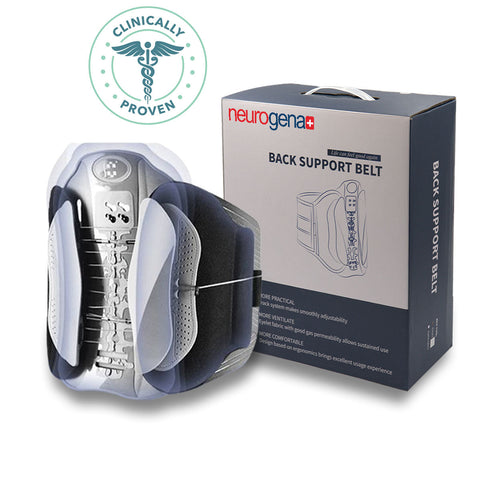
The Neurogena Back Support Belt — invented in the USA, engineered in Germany.
You have rested it. You have stretched it. You have taken something for it. It settles down for a day or two, and by the middle of the week it is exactly where it was.
If that has been the last two years, you are not doing it wrong. Nearly everything people are told to try is aimed at the pain. Almost none of it is aimed at what keeps producing the pain — and that is why the relief never holds.
A lower back like this is not injured once. It is stuck in a loop
Four things happen, and each one causes the next. That is the part almost nobody explains.

The lower-back loop — each stage feeds the next, and the fourth feeds the first.
And then it starts again at one. This is why "give it time" so rarely works here. Something that heals in a straight line gets better on its own. Something that runs in a circle does not.
Which is why rest, stretching and painkillers never seem to hold
None of them are useless. They just each touch one point on the circle and leave the other three running.
| What you were told to do | Where it lands | |
|---|---|---|
| Rest it | Quiets the guarding for a day. The load on the disc is unchanged the moment you stand up. | loop intact |
| Stretch it | Pulls on muscles that are clamped for a reason. If the disc is already loaded, aggressive stretching can flare the nerve worse. | loop intact |
| Take something | Turns down the pain signal. Nothing at all changes at the disc. | loop intact |
Every one of them is a fair thing to try. None of them opens the circle.
The loop opens in one place — take the load off the disc
Break stage one and the rest of the circle has nothing to run on. Less load on the disc means less crowding at the nerve, which means the muscles have less reason to clamp.
This is where an ordinary brace gets it backwards. A cheap elastic belt squeezes your middle — it adds pressure. This one is built to do the opposite: a 10:1 compound pulley lets you gently draw the lower spine open with one hand, taking load off the disc rather than adding to it.
The 10:1 compound pulley amplifies your pulling force for even, adjustable decompression.
And it has to hold the curve, or stage four closes the loop again
Taking the load off is only half of it. If the lower spine settles back into a flattened shape, the disc goes straight back under load and the circle restarts.
That is what the rigid back plate is for. Three arc settings hold the lumbar spine at its natural 26-degree curve while you sit, stand and walk — so the position is kept, not just borrowed for the twenty minutes you were lying down.
The lumbar arc holds the spine at its natural 26-degree curve.
It is the same idea clinics charge for — at home, drug-free, non-invasive
Spinal decompression is not fringe. It is a standard tool in physical-therapy clinics, and people working through sciatica routinely name it as the thing that gave them the most noticeable relief — enough to finally sleep through the night. The difference here is that you are not booking sessions. You are wearing it.
4.7 stars, 627+ reviews — and 60 days to find out on your own back
Two things come up again and again in the reviews: the relief is fast, and it fits real bodies — sizes run to 3XL/4XL. The company backs it with a 60-day money-back guarantee, so finding out costs a shipping label if it does not help you.

"I'm 6'2", 300lbs and ordered an XL and it fit perfectly... it provides tons of support for my lumbar and sciatic."

Customer photo from a verified review.
Where to get it
Sold directly by Neurogena — and backed hard enough that trying it is risk-free.
$199.95$149
- 60-day money-back guarantee — no questions asked
- 2-year warranty included
- Ships from US warehouse in 3–5 days
- Sizes S/M to 3XL/4XL
683 Bought Today · 55,500+ Americans Already Bought
Quick answers
How is this different from the back brace I already own?
Most braces compress — they squeeze the midsection, which adds pressure rather than removing it. This one is built around a 10:1 compound pulley and a rigid arc plate, so it draws the lower spine open and holds it at its natural curve. It is a different job, not a firmer version of the same job.
How long do I wear it?
Start with 30 to 60 minutes a day so your body can adjust, and take it off every two to three hours for a break so the muscles keep working naturally. It is support while you recover, not a permanent crutch.
Will it weaken my core?
That worry comes from wearing a brace all day, every day. Used in sessions, as above, it takes load off while you move — it is not there to replace the muscles.
How fast will I feel something?
Many reviewers describe feeling the pull and some relief the moment they cinch it. Results vary from person to person, which is what the 60-day money-back guarantee is for.
I have a diagnosed disc problem. Is this safe for me?
Ask your physician first. The belt applies gentle, even, adjustable support rather than yanking the spine, but if you have a diagnosed condition or are under a doctor's care, that call is theirs to make, not ours.
This page is an advertisement for the Neurogena Back Support Belt. It is a wearable support product, not a medical device. The four-stage description above is a simplified explanation of how load, nerve pressure, muscle tension and spinal curve interact — it is not a diagnosis and not a recognised clinical classification. Statements on this page reflect the manufacturer's product information and customer reviews and have not been evaluated by the Food and Drug Administration. This product is not intended to diagnose, treat, cure, or prevent any disease, and is not a substitute for professional medical advice, diagnosis, treatment, or surgery. Individual results may vary. If you have a herniated disc, sciatica, or any medical condition, consult your physician before use.
